Earn more from the pens you already have
Fill just 1% more of your pens and you'd take in about twice what Cattery Booking costs. A 20-pen cattery charging £18 a night takes about £1,260 a year more from 1% more occupancy, before the running costs of those stays. Cattery Booking costs it £468 a year.
Every pen-night you fill is almost all profit: the pen, the heating and your time are paid for already. Here's how the system helps you fill more of them – and what it might be worth to you.

Turning people away? That's money walking to another cattery
Every "sorry, we're full" in your busy weeks is a stay you'd have been paid for. And often you weren't quite full – there was room, just not in one place, or not on the right days. Cattery Booking helps you say yes more often:
Fewer gaps in the first place
Each booking goes in the chalet that fits most snugly next to the others – and in your busy weeks it's chosen for you – so a night or two isn't left stranded between stays.
Gaps joined up in one tap
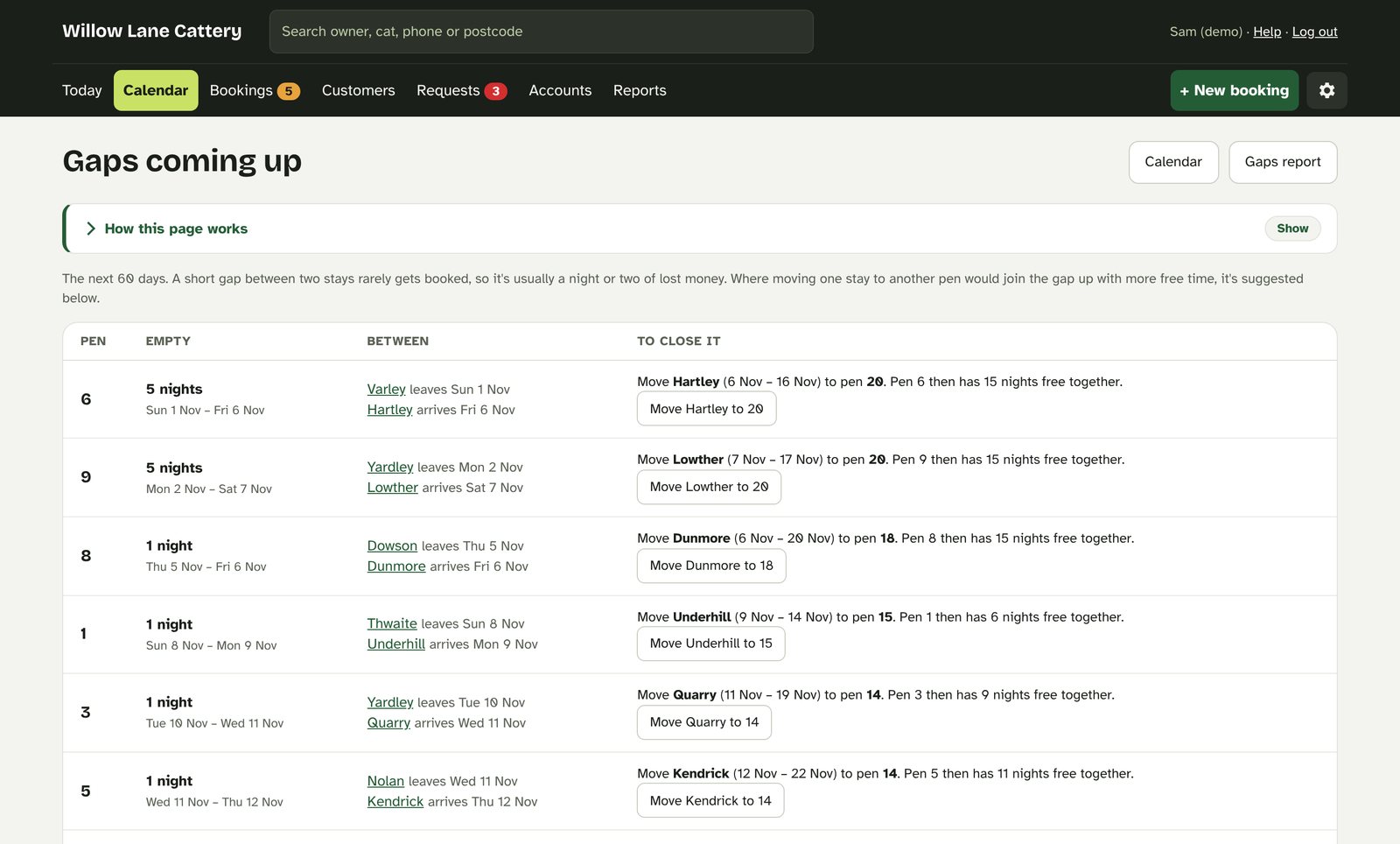
Gaps coming up shows every short gap and the one move that closes it, so two dead nights become a stay you can sell.
Room across two chalets
No chalet free for the whole stay? It finds one that works with a move part-way through – a booking you'd otherwise have turned away.
Cancelled spaces filled
When a stay is cancelled, it tells you who on your waiting list now fits – or offers the space to them, or books them in, as you choose.
Could it have fitted?
Reports check every stay you turned away and tell you whether it could have fitted by moving other bookings round – and how.
Know what you're turning away
Log each "sorry, we're full" in a few seconds. After a busy season you'll see how much demand you missed and what it was worth – the evidence for a slightly higher peak price or a minimum stay.
It only takes a few of those stays to cover the cost of Cattery Booking – three to five extra week-long stays a year bring in enough to pay for any plan, before the running costs of those stays.
And you don't have to take our word for it: every month the system emails you what it earned or saved you, line by line.
What's it worth to you?
An illustration, not a promise – it's simple arithmetic on the numbers you put in. Card fees aren't included. Cattery Booking's price is £29, £39 or £49 a month depending on how many pens you have (founding catteries pay £10 less for their first year).
Close the gaps before they cost you
A night or two left empty between two stays almost never sells. In a quiet month that's a shame. At Christmas, Easter and in the summer holidays – when you're turning people away – it's money you'd already been offered.
Gaps coming up lists every short gap in the next 60 days, with the one move that joins it up: shift one stay to another chalet where it fits snugly, and two dead nights become a week someone will book – often someone already on your waiting list.
- Open Gaps coming up from the calendar
- Read the suggestion – "Move Hartley to pen 20 – pen 6 then has 15 nights free together"
- Press the button. That's it – it checks the pen is free and big enough first
- The price, cleaning list and day sheets follow the move, and it can be undone
- Only stays that haven't started yet, and never a move that just makes a new gap somewhere else
- It learns from your own bookings which gaps really go unsold at each time of year
- And when you book, the best-fitting chalet comes first – so most gaps are never made at all
- In your busy weeks it goes further: the best-fitting chalet is chosen for you, and the warning about a short gap is firmer. The Busy periods report shows which weeks those are, from your own bookings, and what the gaps cost
- Had to say no to someone? Log them as turned away in a few seconds – no customer record needed – and you'll see how much demand there really is when you're full
For example: join up one gap in the summer holidays and let it to two cats sharing for 5 nights at £25 a night – that's £125, more than four months of Cattery Booking, from a single tap. More on making room →
Every way it helps you earn more
All of these are in every plan. Each one says what it does and how it helps – most catteries only need a few of them to cover the cost of Cattery Booking.
Fill more nights
Best fit when booking
How it works: The chalets that fit most snugly next to other stays are listed first. You're warned before a booking leaves a gap too short to sell, with a better chalet offered in one tap – and website requests that book themselves go in the best fit automatically.
How it helps: Fewer nights stranded between stays, so more of your chalet-nights can be sold.
Busy weeks: the best chalet chosen for you
How it works: Your busy weeks are found from your own bookings (and your peak times). Booking in them, the best-fitting chalet is chosen for you and the warning about a short gap is firmer.
How it helps: Protects the nights that are worth most – the ones you'd otherwise be turning people away for.
Gaps coming up
How it works: Every short gap in the next 60 days, with the one move that joins it up – one tap, checked first, and it can be undone.
How it helps: Turns two dead nights into a stay someone will book.
Stays across more than one chalet
How it works: When no chalet is free for the whole stay, it finds one that works with a move part-way through – one booking, one price, on both chalets' day sheets.
How it helps: A booking you'd otherwise have turned away.
Same-day turnaround
How it works: If cats go home by a set time and new ones arrive from a later one, a chalet freed in the morning can take a new cat that afternoon, with cleaning in between. (For catteries that charge per night.)
How it helps: Busy changeover days don't cost you a night per chalet.
Busy periods and the Gaps report
How it works: Which weeks you were nearly full, the nights left in gaps too short to sell, what they were worth at your prices, and how many more stays there was room for.
How it helps: Shows you where the money is being lost – and which weeks to guard next year.
Win more bookings
Bookings while you sleep
How it works: Customers send requests from your website any time. Each arrives checked for room and vaccinations; safe ones can book themselves straight in, with the confirmation emailed automatically.
How it helps: You catch the people who'd otherwise have tried the next cattery on the list.
Cancelled spaces filled
How it works: Full? Put them on the waiting list – or let them tick it on your request form. When a stay is cancelled, you choose what happens: you're told who now fits, the space is offered to them by email (first to say yes gets it), or they're booked in automatically.
How it helps: A cancelled stay can become another booking instead of an empty chalet.
Who to ring, before it's too late
How it works: Regulars who usually come at this time of year but haven't booked yet, with their number.
How it helps: Fills your busy weeks with people you already know, before they go elsewhere.
See the busy times coming
How it works: How Christmas, Easter and the summer are filling against last year, and what's likely to come in over the next three months.
How it helps: An early warning while there's still time to do something about a slow start.
Answer first
How it works: How quickly website requests are answered, and how many become stays – with a red count on Requests so none sit waiting.
How it helps: People asking several catteries tend to go with whoever answers first.
A website that runs from your booking system
How it works: We build cattery websites whose prices, opening hours, news banner and booking requests come straight from Cattery Booking – you change them in seconds, no technical knowledge needed. (A separate service.)
How it helps: A better website brings more enquiries – and it's always up to date.
Charge the right price
Peak prices and minimum stays
How it works: Higher prices and minimum stays for Christmas, Easter and the summer – with peak dates suggested from the weeks you were really busy last year.
How it helps: Your busiest weeks earn what they're worth, and short stays don't block long ones.
Prices that work harder
How it works: The weeks you were 95% full or more (and whether peak prices covered them), your quietest weeks, and your best customers.
How it helps: Shows exactly where a small price rise wouldn't cost you a single booking.
Know what you're turning away
How it works: Log each "sorry, we're full" in a few seconds – no details needed. Reports add them up with declined requests and the waiting list, and check whether each could have fitted.
How it helps: Real evidence of unmet demand – for a peak price, a minimum stay, or more chalets.
Extras and charges you'd forget
How it works: Extras like medication or collection, a pick-up charge, and a late-collection charge offered at check-out.
How it helps: Money for things you already do, without having to remember to ask.
Keep customers coming back
Win the 2nd and 3rd stays
How it works: A Welcome back offer – a small discount on the 2nd and 3rd stays – with an optional thank-you email, and a report of what it's won you.
How it helps: Customers who've stayed three or four times nearly always keep coming.
Photo updates and webcams
How it works: Email the owner a photo during the stay in a tap; let owners watch their cat on your webcams, with a login that only works while they're staying.
How it helps: Owners remember you, tell friends, and book again.
Bring regulars back
How it works: How many customers come back after their first stay, and regulars you haven't seen for a year.
How it helps: A friendly call to a lapsed regular costs nothing and often brings a booking.
Lose less
Card deposits
How it works: Ask new customers – or everyone – for a deposit by card with their request, into your own Stripe account, refunded automatically if you decline.
How it helps: Fewer no-shows and late cancellations in your busy weeks.
Reminders before every stay
How it works: Emails and texts a few days before arrival, with the arrival time, anything still to pay, and a note if a vaccination doesn't cover the stay.
How it helps: Fewer no-shows and fewer stays falling through at the door.
Vaccinations checked for the whole stay
How it works: Warnings before arrival when a vaccination is missing or runs out during the stay.
How it helps: No turning a cat away on the day – and no empty chalet.
Late cancellations, counted
How it works: What late cancellations cost you, and what a deposit would have covered.
How it helps: Tells you whether a deposit or cancellation charge would pay.
From a real cattery's records
Four years of real bookings at Wolviston Village Cattery, a 30-room cattery that's full for weeks at a time in the holidays:
8 stays – enough to cover a year of Cattery Booking (£468 on the £39 plan)
These are real bookings from Wolviston Village Cattery, every year from 2022 to 2025. In their busiest times – the summer holidays, the May/June half-term, Easter and Christmas – at least 27 of their 30 rooms (over 90%) were taken, yet about 478 room-days a year still sat empty in gaps of one to three days – too short for most holiday bookings. Joining up gaps is new in Cattery Booking – their old booking system couldn't do it – so this is what was being missed. With the same bookings rearranged, those scraps of time become gaps of four or five days or more: long enough for a typical stay, in weeks when people were asking for rooms. We can't say for certain how many would have been booked – phone enquiries they turned away weren't recorded – and that's the most it could have been: the tool only moves stays between similar rooms, and whether a space sells depends on a lot of things. So we'd put it at £1,000 to £3,000 a year for Wolviston: about £3,000 if every one of those spaces had sold, around £1,000 if a third had. Based on their own booking history – how full they were and how often those dates were asked for – that's a reasonable range. Either way it would pay for itself if only 1 in 5 to 1 in 7 of those possible stays happened. The workings, step by step →
And what you save
One simple price
Every feature on every plan, with no setup fee and no contract. Free text reminders every month instead of a monthly add-on.
Time back every day
A summary email first thing, the cleaning list after each departure, prices that work themselves out, and the next fortnight day by day so you know when you need an extra pair of hands.
Staff hours matched to the work
An estimate of the hours each day's bookings need – cats, arrivals, cleaning, medication – against your usual rota, your average week day by day, and the quiet weeks for holidays. A guide to plan with, using your own times: always keep enough staff to care for the cats and meet your licence.
Late cancellations, counted
What cancellations in the week before arrival cost you, and how much a deposit would have covered.
Mistakes that don't cost you
Warnings before a night goes over your licence limit, undo for almost anything, a record of every change, and nightly backups.
Move across in an afternoon
Bring your records from a spreadsheet, KennelBooker or Revelation Pets, and check it all before anything is saved. On paper? Send photos of your diary and I'll type it in, free.
Start my free month Try the demo – no sign-up See the prices